Anglo-French hostilities
Last and First MenAnglo-French hostilities were a war shaped by a false accusation, an accidental bombing, and a peace gesture that nearly redirected history. The conflict devastated England and France, but its larger significance lies in the narrow interval when public feeling and government action seemed capable of overcoming tribal allegiance. A chance accident closed that interval, renewed the war, and helped produce a more durable European unity only after both nations had been shattered.
Causes and the fragile peace
The dispute emerged from a long rivalry between France and England, but its immediate public pretext was a reported assault by a French African soldier on an Englishwoman. The allegation was false: it grew out of a private encounter in southern France that the woman later misrepresented. The British Government accepted the charge, while the English press magnified it, appealing to sexuality, national prejudice, and moral self-righteousness. Abuse and occasional violence against French people in England followed, strengthening the French militarists who had been looking for an opportunity to act.
Behind the public quarrel lay a more consequential dispute over air power. France had persuaded the League of Nations to limit the size of military aircraft in a way that left London within easy reach of the French coast while making Paris difficult for England to attack. England pressed for the restriction to be removed; meanwhile, French advocates of complete aerial disarmament appeared strong enough that the French Government might have accepted it. The militarists feared that this opening would disappear. Rumours that England was secretly building long-range planes worsened French suspicions, and when war came the British air force proved capable of a much wider range of action than expected.
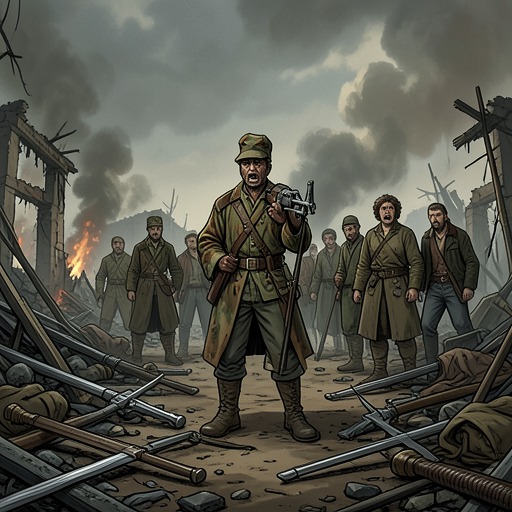
The conflict began with an attack that caught England by surprise. Enemy planes appeared over London while newspapers were still reporting the declaration of war. Within hours, a third of the city lay in ruins and much of its population had been poisoned. A bomb near the British Museum devastated Bloomsbury, destroying a substantial part of England’s cultural inheritance and intellectual life. The scale of the attack did not, however, immediately determine the war’s political meaning: in a cellar beneath Downing Street, the British Cabinet considered a response that rejected retaliation.
The peace message and the accident
During the bombardment, an idealistic member of the British Cabinet urged the Government to send France a message of brotherhood. Its proposed substance was striking: England acknowledged the catastrophe, declared that hostility would cease, and appealed to the shared humanity and complementary cultural strengths of the two peoples. The message was not a plea for mercy; England’s resources and armament remained intact. After brief discussion, the Cabinet ordered it sent. Its members were themselves unsettled by the decision, unsure whether they had been seized by a force for good or evil.
The message produced an unfamiliar atmosphere in London. Amid the city’s suffering and disorder, those who remained experienced a sense of shared participation in an unprecedented moral act. In northern England, people initially debated whether the Government’s pacificism was cowardice or courage, but increasingly accepted the latter interpretation. France, too, divided between triumphalism and bewilderment. As the hours passed, the bewildered party found a public voice in support of England and humanity. The account presents the prospect of peace as real, not merely symbolic: the French party of peace had taken control, and a victory for restraint seemed likely.
The reversal came on the Saturday after the Friday-night bombardment. A French plane descended over the western outskirts of London. Onlookers took it for a messenger of peace, but an object fell from it and exploded near a large school and a royal palace. The school was badly damaged, while the palace escaped; a popular young princess was killed. The plane then crashed and burned. In retrospect, the circumstances pointed to an aircraft in distress rather than a deliberate attack, but those watching the destruction had little opportunity for calm judgment. The death of the princess, already a powerful public symbol, made the accident especially combustible.
Renewed war and mutual ruin
The news was relayed across England in a distorted form that presented the explosion as a deliberate act by France. London’s mood changed within an hour, and the country fell into an outburst of hatred. England’s well-equipped air force was sent against Paris. The escalation came just as France’s militaristic Government had fallen and its party of peace had taken control: its supporters still crowded the streets when the first bomb fell.
By Monday morning, Paris had been obliterated. Fighting continued for several days, with civilian populations caught in the destruction. The better-organized British air force soon made it impossible for French planes to take off, but England was too crippled to exploit that advantage. In both countries, urban life had broken down; famine, disorder, looting, and the spreading disease brought hostilities to a halt. The result was not a decisive settlement but the exhaustion of two societies no longer able to sustain either warfare or hatred.
Reconstruction and the altered political climate
The League of Nations temporarily assumed the management of both countries, which depended substantially on outside help to reconstruct. The aftermath differed from the peace that followed the European War, later called the War to End War. That earlier settlement had left reparations, security disputes, and opposing camps in place. After Anglo-French hostilities, there was no comparable campaign for reparations or alliances. The collapse of national institutions, the rise of pacifist and anti-nationalist Labour, and the League’s authority to investigate and publicize how the war began all helped change the political climate. England and France cooperated not only in rebuilding themselves but also in rebuilding one another.
This reconciliation did not restore their former influence. England’s sobering role in Europe diminished after economic pressures and the war’s disintegration, while France’s cultural life was gravely reduced. The narrative connects France’s vulnerability to an excessive nationalism that had turned admiration for its own culture into contempt for other peoples. The war therefore weakened both the cultural powers whose rivalry had helped set it off, even as its aftermath temporarily reduced national antagonism.
Historical significance and the road ahead
The account treats the conflict as an example of how an apparently minor accident can redirect a vast historical process. Had the French plane not gone astray after the British message, England and France might have escaped devastation. The fragile movement toward unity could have acquired the confidence it lacked and become a lasting policy grounded in trust, rather than a reaction that followed each new catastrophe. The narrative cautiously imagines that European and perhaps worldwide unification might then have come earlier, before the long period of mental deterioration that followed repeated wars; the First Dark Age might have been avoided.
That possibility makes the war more than a contest between states. It exposes the gap between people’s capacity to recognize a common humanity and their susceptibility to fear, rumour, and national symbolism. The struggle for peace was strong enough to influence governments and crowds, yet not strong enough to withstand one accident interpreted through inherited hostility. In the longer history, distrust of human nature after the war contributed to the formation of the European Confederacy, in which European nations other than Russia surrendered sovereignty to a common authority and pooled their armaments. Unity advanced, but only after the chance for a less destructive passage had been lost.